
None of Your Systems Are Broken. They Are Just Not Talking to Each Other. And That Is Costing You Six Figures.
Most construction companies do not have one big problem. They have five small ones that quietly multiply each other every single day. Here is what that is actually costing you.
Ask any construction owner what their biggest operational problem is and you will rarely hear one clean answer.
It is usually a list. Billing is slow. Job costs are hard to track. Someone is always re-entering the same numbers twice. The office never quite trusts the field data. Decisions get made on gut feel because nobody has time to pull a clean report.
Here is the thing almost nobody connects until someone points it out to them. Those are not five separate problems. They are five symptoms of the exact same root cause.
Your systems do not talk to each other.
A timekeeping app you added in 2018. Accounting software from 2020. A project management tool from 2022. A messaging app whenever someone new joined the team. Each one solves its own piece of the puzzle. None of them know the others exist. And the gaps between them are exactly where your time, your money and your accuracy quietly disappear.
Walter owns a multi-trade construction company in Wisconsin with 31 field employees. When he first heard the phrase “your systems don't talk to each other,” his instinct was to push back. His systems worked fine individually. His timekeeping app did what it was supposed to do. His accounting software was solid. His project management tool had served him well for three years.
It took an honest afternoon of tracing his own numbers to realize the problem wasn't any single piece. It was every gap between them. When he finally calculated what those gaps were costing him across a full year, the number was $127,000.
Here is what that number was actually made of.
The hidden cost of disconnected systems for a mid size construction company, ten to fifty field employees, runs between $50,000 and $200,000 a year. It never shows up as one line item. It bleeds out through double entry, delayed billing, stale decisions and admin overhead, a little at a time, every single day.
These costs do not add up. They multiply each other. And that is exactly why fixing one piece in isolation rarely solves the real problem.
The 5 Costs You Are Paying Every Single Day
Most of these will sound familiar the moment you read them, because they are quietly happening inside almost every construction business that has not unified its systems. Here is what each one actually looked like inside Walter's company.
Double data entry. Every time the same piece of information gets typed into two systems, you are paying for that labor twice and doubling the chance an error sneaks in. Most construction companies re-enter field data into three or four different systems before it ever becomes an invoice. Walter's office manager was retyping labor hours into three separate systems every week. He calculated that habit alone cost him roughly $19,000 a year in labor once he accounted for the errors it introduced.
Delayed billing. Disconnected systems create handoffs. Each handoff adds one to three days to your billing cycle. A five handoff process means you are sending invoices five to fifteen days later than you could be, and financing that gap yourself the entire time. Walter's average billing cycle was 31 days from work complete to invoice sent. On his annual revenue, that delay alone was tying up roughly $340,000 of his own cash at any given moment, money he had already spent on labor and materials.
Stale decision making. When your project manager's job cost data comes from a different system than your billing data, neither one is actually current. Decisions get made on last week's numbers, and overruns do not get caught until it is too late to do anything about them. One of Walter's jobs finished $31,000 over budget two years ago because the labor overage had been invisible for the final three weeks of the project.
Admin overhead. Someone on your team has effectively become the human glue holding your systems together. Pulling data from here, formatting it for there, reconciling discrepancies that should not exist in the first place. That role only exists because your systems do not connect. For Walter, that was almost an entire role, roughly 14 hours a week split across two staff members who were essentially employed to compensate for systems that didn't talk to each other.
Lost trust in your own data. When the numbers do not match across systems, people eventually stop trusting any of them. They go back to gut feel. This is the most expensive cost of all, because at that point you are running the business partially blind and you do not even realize it. Walter's project managers had quietly stopped relying on his official reports a year before he addressed any of this. They were managing by instinct and hoping the final numbers came out close.
Read that list again and notice something important. None of these are people problems. Every single one of them is a connection problem.
Why These Costs Multiply Instead of Just Adding Up
Here is the part that makes disconnected systems so much more expensive than they first appear.
Delayed billing means your job cost data is also stale, because the same broken pipeline carries both. Stale data means worse decisions, because nobody is reacting to what is actually happening right now. Worse decisions mean more admin time spent fixing problems after the fact instead of preventing them. More admin time means higher overhead. Higher overhead means tighter cash flow. And tighter cash flow means you cannot invest in fixing any of the upstream problems that caused all of this in the first place.
That is the loop. It is not five separate problems sitting side by side. It is one spiral, and every piece of it makes the next piece worse.
This is also exactly why a lot of owners try to fix one thing, a new app here, a better spreadsheet there, and feel almost no relief.
You patched one leak in a boat with five leaks. The water keeps coming in from everywhere else.
Walter had tried exactly this twice before, a new scheduling app one year, a better spreadsheet template the next. Both felt like progress for about a month. Neither one touched the other four leaks.
What Disconnected Actually Looks Like Versus Connected
It helps to see this side by side rather than just talking about it abstractly.
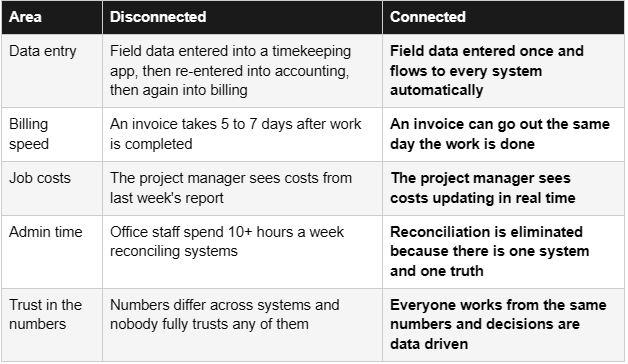
Look at that comparison and ask yourself honestly which column describes your business right now. Most owners find themselves somewhere uncomfortably close to the left side. Walter did too, for every single row, until he didn't.
What Fixing This Actually Meant for Walter's Business
This brings us to the real question underneath everything in this blog series.
If you could dramatically reduce your billing cycle, eliminate manual data re-entry, and see real time profitability across every job you have running right now, what would that actually mean for your business?
For Walter it meant his 31-day billing cycle became a 6-day one. It meant the $340,000 he was financing out of his own pocket at any given moment dropped to under $60,000. It meant his project managers started trusting the official reports again because the numbers finally matched what they saw in the field.
For most owners the honest answer is not just about saving money, even though the money is real. It is about something bigger. It is the difference between reacting to your business and actually running it.
“I pushed back hard the first time someone told me my systems didn’t talk to each other. I thought that was a strange thing to say about tools that each worked fine. It took seeing the actual number, $127,000 a year, to understand they meant the gaps, not the tools. Once we connected everything, I stopped being the only person who could see the whole picture. That changed more than the money did.”
Walter B., Owner, Northfield Multi-Trade Construction
It means knowing today, not next month, whether a job is on track. It means sending an invoice the same day a milestone is hit instead of two weeks later. It means walking into a bank or a bonding company conversation with real numbers instead of estimates. It means your office team stops being the human glue holding five disconnected tools together and starts doing work that actually grows the business.
Real time data creates clarity. Clarity creates control. And those two things together are what separate the construction companies pulling ahead of their competition from the ones quietly treading water year after year.
Rate Your Own Tech Stack in Under 2 Minutes
Here are five quick yes or no questions that tell you a lot about where you actually stand.
• How many different tools touch one invoice from start to finish? If the answer is four or more, you are a strong candidate for consolidation.
• How often does the same data get entered into multiple systems? More than twice per billing cycle means you are paying an invisible tax every single time.
• Who on your team spends real time reconciling systems? If reconciliation exists as an actual job function, a unified system eliminates it entirely.
• Can you see real time financial data across all of your jobs in one place right now? If the answer is no, you do not have a platform, you have a collection of separate tools.
• Is your current tech stack what is actually holding your business back from its next stage of growth? If you found yourself nodding, that is worth paying attention to.
One or two yes answers and your current setup is probably serving you fine for now. Three yes answers and it is worth starting to explore your options without urgency. Four or five yes answers and your patchwork of tools is actively costing you money every day you wait. Walter answered yes to all five.
Want to See the Full Picture Across All 6 Areas of Your Operation?
The five questions above give you a quick read on your tech stack specifically. But disconnection rarely stays contained to just one area, which is exactly what Walter discovered.
Business impact is the final piece that ties together everything we have covered in this series: field to office speed, crew accuracy, billing process, project manager visibility, and financial control. We built a free 3 minute diagnostic quiz that scores you across all six areas at once.
When you finish you get a personalized score for each area, specific recommendations matched to your exact answers, and a free resource sent to you based on wherever your biggest gap is right now.
Most owners who take it tell us this final question is the one that puts everything else into perspective, because it forces you to picture what your business would actually look like with every piece connected instead of just patched together.
It costs nothing. Takes 3 minutes. And it will show you exactly where your biggest opportunity is.
TAKE THE FREE 3 MINUTE QUIZ NOW
Rather talk it through first?
Book a free Business Roadmap Session and we will walk through your current tech stack together, map out exactly where the disconnects are costing you the most, and show you what consolidating onto one real time platform would actually look like for your specific business. No pitch. No pressure. Just a genuinely useful 30 minute conversation.
BOOK YOUR FREE BUSINESS ROADMAP SESSION
PathfinderLink is the unified platform built for construction companies ready to leave the patchwork behind. One system. Real time data. Total clarity. Complete control.
