
Solving Crew Management Challenges with Better Time Data
Most crew management problems aren't really people problems.
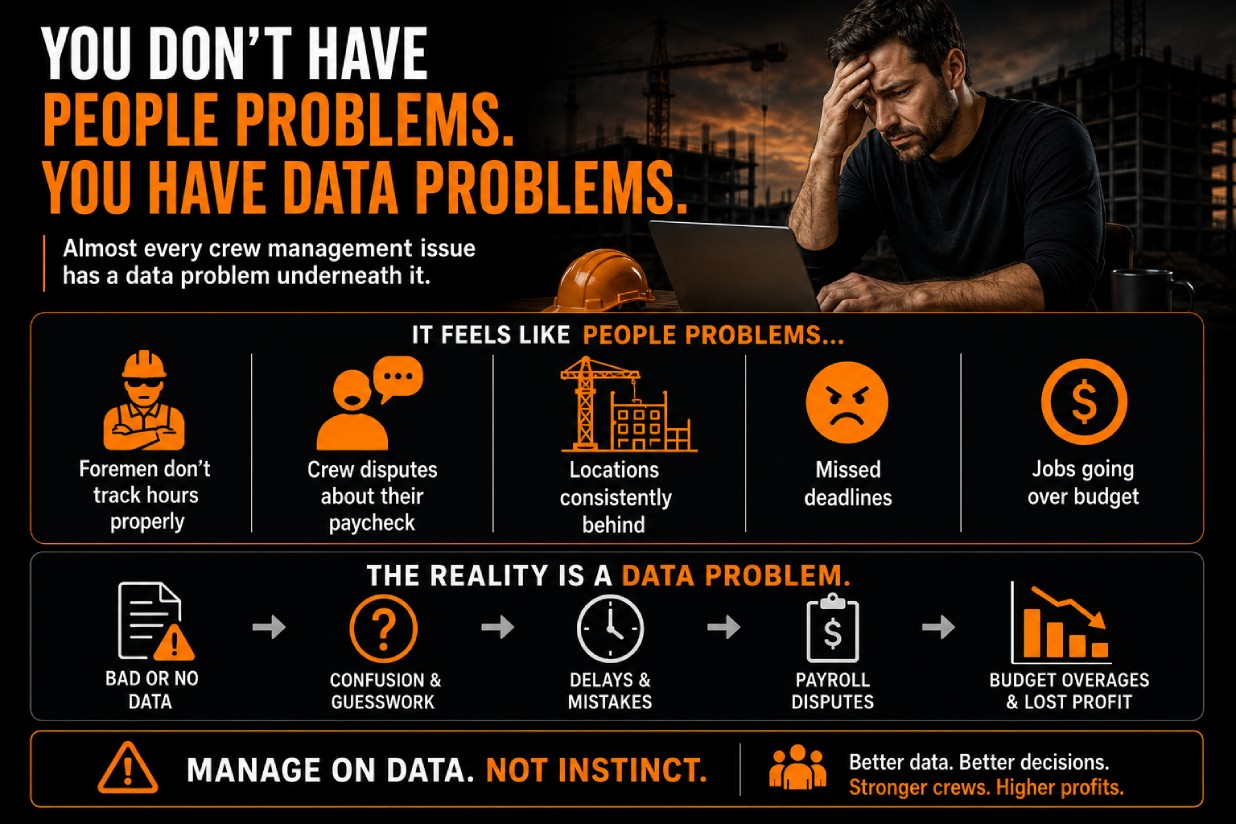
They feel like people have problems. The foreman who doesn't track hours properly. The crew member who always has a dispute about their paycheck. The location that's consistently behind while the others run clean.
But pull back the lens and almost every one of those problems has a data problem underneath it.
You don't have bad crew members. You have a system that gives you bad or no information. And when you're managing on instinct instead of data, the gaps show up as people problems.
Anthony owns a general contracting company in Pennsylvania. Forty-four employees, three active sites at any given time, and a foreman at each location who runs things the way they were always run. When he came to us, he had five problems he'd been trying to solve for two years. He thought four of them were people problems.
They weren't.
Here's what better time data actually solves.
"I Don't Know If They're Actually On Site"
Paper sign-ins run on an honor system. For most crews, that works most of the time. But "most of the time" isn't a compliance position. And it's not a billing position either.
Anthony had a billing dispute with a client last spring over hours logged on a day his crew swore they were on site. He had no way to verify it. The client pushed back on four hours. Anthony absorbed the cost rather than fight a battle he couldn't prove. It was $300 he'd already paid his crew. Gone because there was no record.
Geolocation clock-in closes this without turning into surveillance.
When a worker clocks in, their location is verified. You can see they're at the job site, not on the way, not at the supply house, not still in the parking lot. That's it. No tracking of movements throughout the day. Just a verified timestamp and location at the start of work.
One data point. Eliminates an entire category of disputes.
"Jobs Are Going Over Budget and I Find Out Too Late"
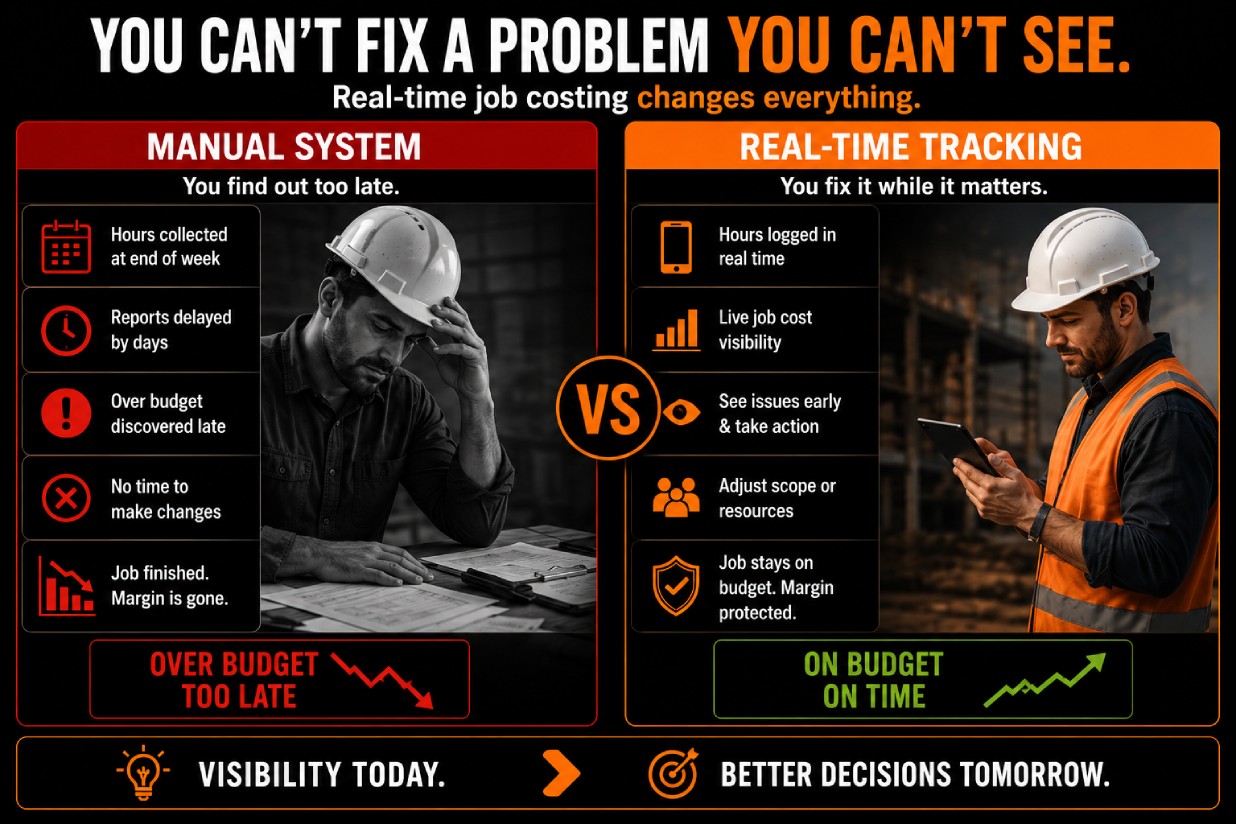
This is the most expensive crew management problem because by the time you know about it, you can't fix it.
It happens because most contractors don't have visibility into actual vs. budgeted hours while a job is in progress. They see the final number. After. When the invoice doesn't match the estimate or the client pushes back.
Real-time job costing flips this.
When hours are logged against job codes as work happens, you see where every active job stands today. A job trending over budget at 70% complete shows up in your dashboard now. Not next week. You can have a conversation, adjust scope, or redirect resources while it still matters.
That's the difference between managing problems and cleaning up after them.
"Payroll Disputes Keep Happening"
A worker who feels shorted is a worker who's mentally somewhere else, whether the error was real or not.
When time records are accurate, automated, and auditable, disputes become resolvable in minutes. You pull up the record. You see exactly what was logged, when, and from where. Genuine errors get corrected quickly. Inaccurate claims get answered with evidence, not a conversation that goes in circles.
The audit log is your protection. Every clock-in, clock-out, and edit is recorded. Who did it. When. From where.
That's not micromanagement. That's accountability infrastructure. And once your team knows the records are clean and verifiable, disputes drop on their own.
"Managing Multiple Locations Is Making Me Crazy"
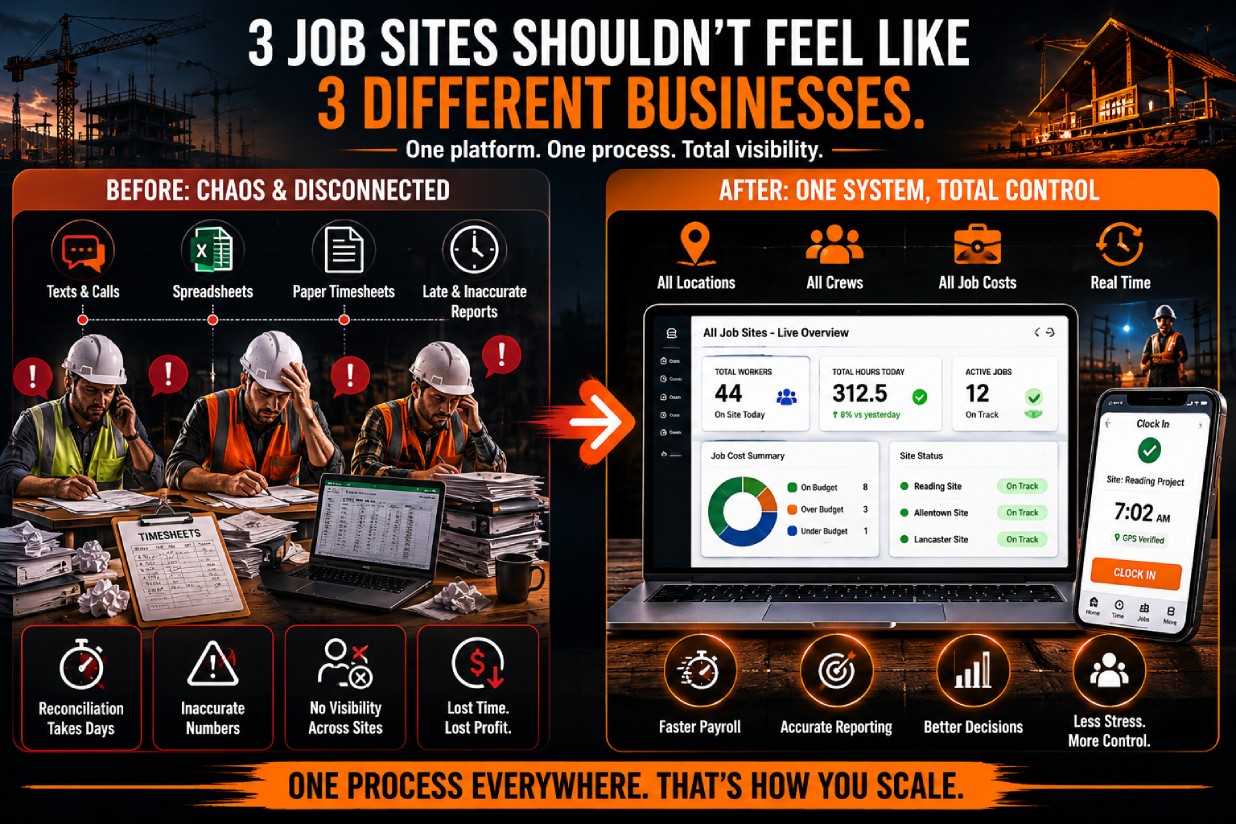
Single-location businesses have crew management challenges. Multi-location businesses have all the same challenges, times however many locations you're running.
For Anthony, three sites meant three completely different reporting processes. His site in Reading texted hours in. His crew in Allentown used a spreadsheet their foreman had built himself years ago. His third site submitted paper at end of week, usually Friday afternoon, usually incomplete. By the time Anthony had collected and reconciled everything, it was Tuesday of the following week and he still wasn't fully confident in the numbers he had.
He couldn't see across his own business. Each site was its own information island.
One platform. One process. One dashboard, all locations, all crews, all job costs, updated in real time.
When the data is consistent across locations, managing three sites isn't three times harder than managing one. It's just more of the same clean process.
"My Best Foreman Is My Worst at Paperwork"
This is real. And it's awkward to solve through management alone.
Your best field operator, the one clients love, the one the crew follows, might be the one whose time tracking is consistently incomplete. And you can't afford to lose them over it. But you also can't run payroll on incomplete data.
The fix isn't retraining your best operator. It's making the process so easy that good data requires almost no effort.
Crew clock-in means one foreman can log their entire team in seconds at shift start. Job code assignment happens at clock-in, not as a separate step later. The administrative burden drops to near zero.
When the process takes five seconds, your best foreman can do it. And your data gets clean without a management conversation you didn't want to have.
What Better Data Actually Unlocks
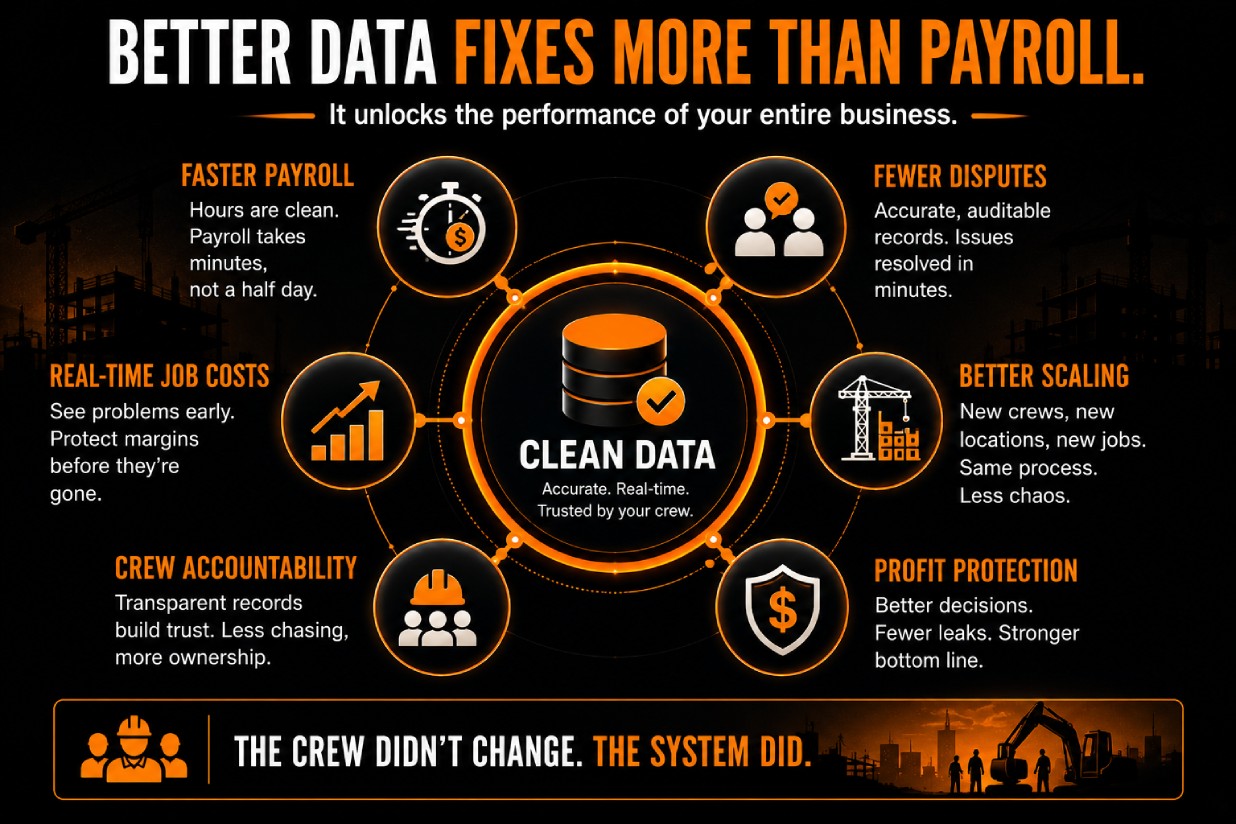
When time data is accurate and real-time across your whole crew, a few things happen.
Payroll stops being a crisis. Hours are already in the system, clean. Payroll prep takes minutes, not a half day.
Job performance is visible early enough to matter. You catch overruns before they're overruns. You manage with information instead of instinct.
Scaling stops feeling chaotic. New crews, new locations, new jobs, they all plug into the same system. Growth adds work, not disorder.
Your team trusts the numbers. When records are accurate and transparent, disputes drop. Trust goes up. Foremen stop being defensive because the records speak for themselves.
What Anthony's Operation Looks Like Now
Six months after fixing the data, Anthony's five problems look different.
The foreman who used to miss time entries is clocking in his whole crew in five seconds at shift start. The crew member who always disputed his paycheck hasn't raised one in three months because the records are there and he can see them. The location that was consistently behind now runs on the same system as the other two and the performance gap turned out to be a data gap, not a people gap.
His three sites report in one dashboard. He can see every active job's labor cost in real time from his phone. Payroll takes forty minutes instead of most of a Thursday.
The crew didn't change. The system did.
“I spent two years thinking I had people problems. Turns out I had one problem and it was the data. Once the data was clean, everything else started sorting itself out. My foremen stopped being defensive. My payroll stopped being a fight. And I could actually see what was happening across all three sites without making six phone calls.”
Anthony R., Owner, Ridgeline General Contractors
That's what the opening promised. You don't have bad crew members. You have a system that gives you bad information. Fix the system and the crew you always had shows up in the numbers.
See How TotalTime Handles Crew Management
TotalTime was built specifically for contractors managing field crews from 5 employees to 500+. Geolocation clock-in. Crew clock-ins in seconds. Real-time job costing. Full audit log. Direct integration with QuickBooks and Acumatica.
• Book a free demo at crm.pathfinderlink.com/get-a-demo, no sales pressure, just real results
• Download the free Payroll Accuracy Guide at crm.pathfinderlink.com/fix-payroll-at-the-source
• Call the TotalTime team directly: 866-360-0449
Built for real job sites. Trusted by teams who don't have time for do-overs.
