
Time & Materials Tracking: A Complete Guide for Contractors
T&M contracts should be the easy ones.
You do the work. You track the time. You track the materials. You bill the client. Simple.
Except it's never simple.
Hours get logged at end of day instead of as they happen, and end-of-day is generous. More often it's end-of-week, from memory, in a truck on the way back to the yard. Material receipts disappear into glove boxes. A crew member picks up $300 of supplies at the supply house and nobody writes it down because "we'll sort it out later."
Later comes. Nothing got sorted. You bill what you can remember.
And you leave money on the table. Every single cycle.
Pete runs a 22-person plumbing and mechanical service company in Illinois. About 60% of his work is T&M. When he sat down at the end of last year to figure out why his margins looked worse than his workload justified, he started adding up the hours he couldn't account for.
The number he came up with stopped him cold.
Here's how to stop that from happening to you.
Where the Money Actually Goes
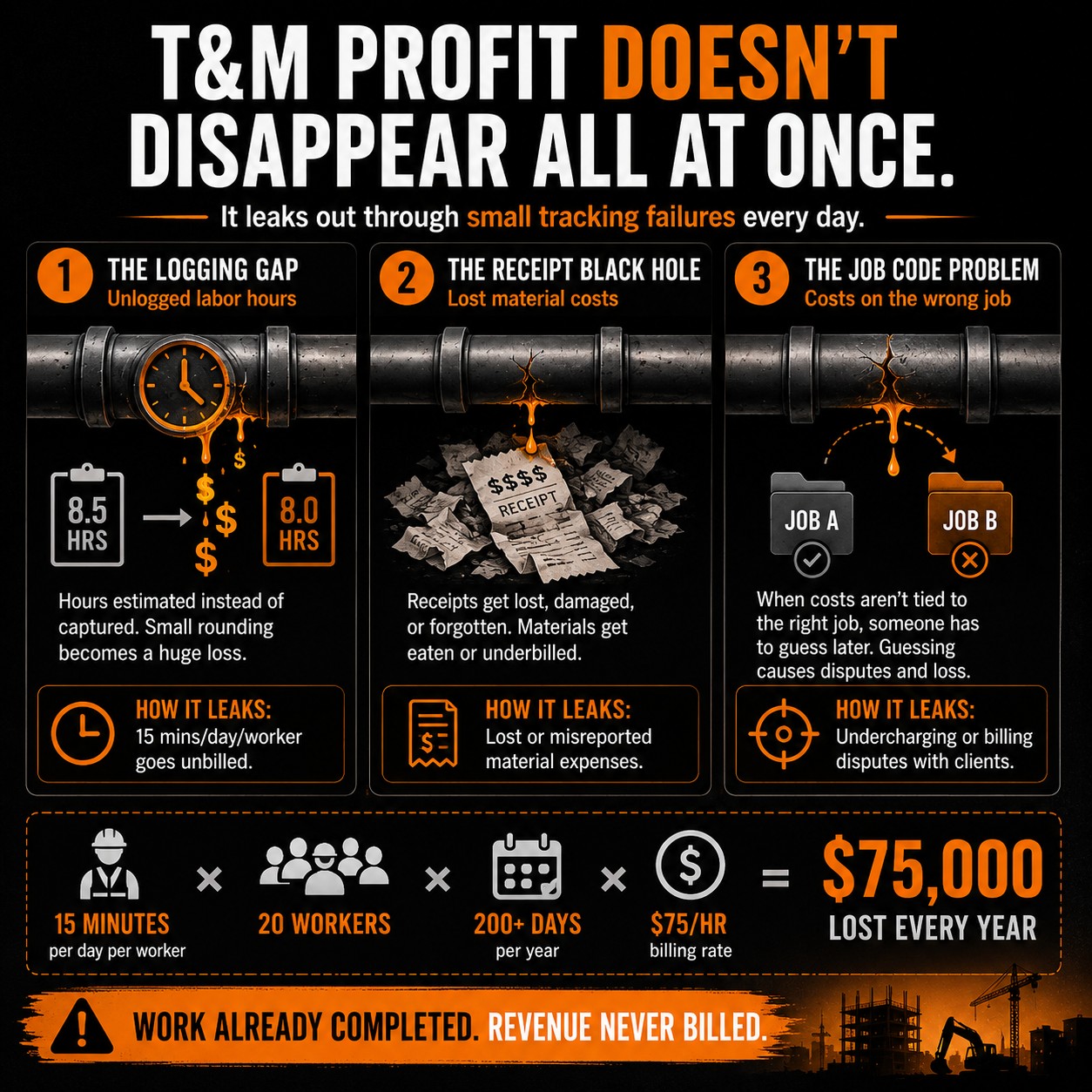
There are three places T&M profit disappears. Every contractor has all three, they just don't always know it.
The logging gap.
If hours aren't recorded at the moment of work, they get estimated. And estimates are always conservative. A worker who did 8.5 hours logs 8. A job that touched two sites gets attributed to one. Small rounding across a 20-person crew, over 200 working days, is not a small number.
Do the math:
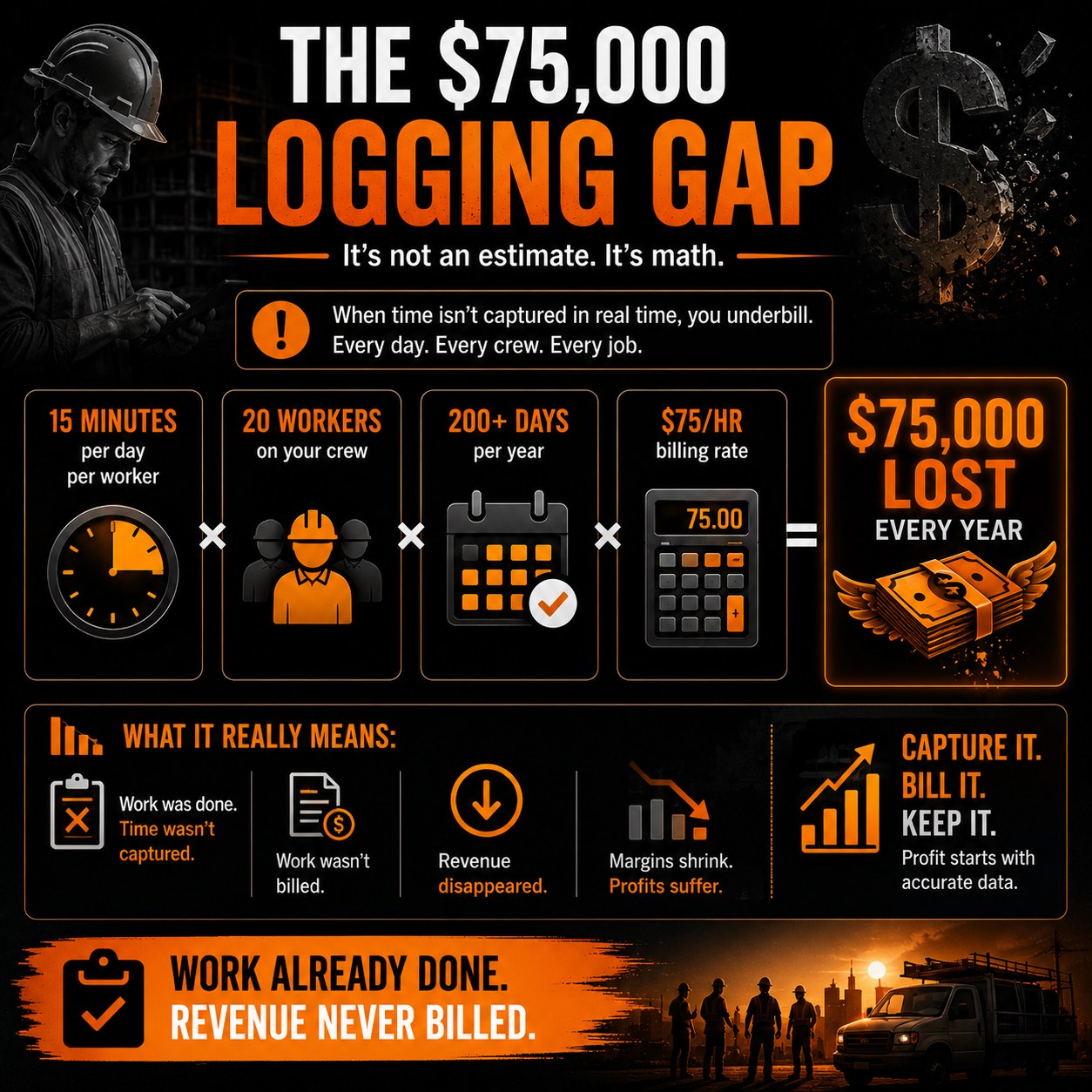
15 minutes per day per worker, at a $75 billing rate, across 20 workers.
That's $375 per day. $75,000 per year. Unlogged. Unbilled.
That was Pete's number. Not an estimate. Not a hypothetical. When he went back through six months of completed T&M jobs and compared what was billed to what he could reconstruct from crew conversations and site notes, the gap was just under $38,000 for the half year. Annualized: more than $75,000 walking out the door every year on work that was already done.
The receipt black hole.
Paper receipts get wet, get lost, get thrown away with the coffee cup. A $400 material purchase that doesn't make it to the office either gets eaten or estimated. Usually both, first estimated wrong, then disputed.
The job code problem.
When hours and materials aren't tied to the right job at the point of capture, someone has to do that reconciliation later. And "later" means guessing. Guessing means errors. Errors mean undercharging or a billing dispute with a client who's now questioning everything.
What T&M Tracking Actually Needs to Do
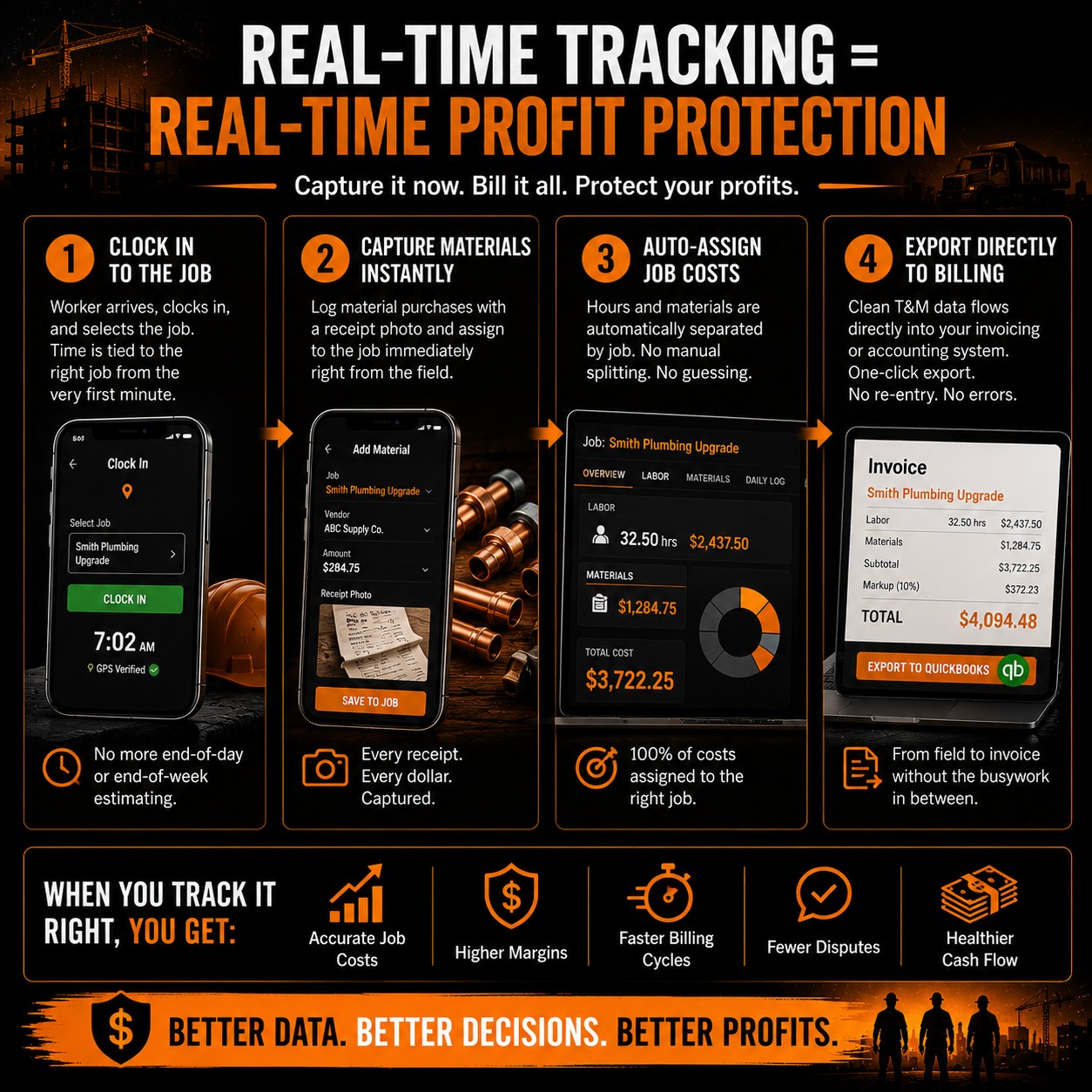
Four things. All in real time.
Capture labor at clock-in. The worker arrives. They clock in. They pick the job. That's it, the time is now tied to the right job from the first minute. Not at end of day. Not on Friday.
Attach materials at the point of purchase. Field staff log material costs with a receipt photo to the job code immediately after buying. From their phone. In the truck on the way back to site. Not when they get to the office next Tuesday.
Separate costs by job automatically. When one crew works two jobs in a day, hours split correctly without anyone doing it manually in the back office. Every hour knows which job it belongs to.
Feed your billing workflow directly. Clean T&M data, labor and materials, flows into your invoicing or accounting system without a transcription step. One-click export. No re-entry. No errors introduced at the last mile.
If your current setup is missing any of those four, you're leaving money somewhere.
The Habit That Changes Everything
Policies don't fix T&M tracking. Habits do.
The difference: a policy is something your team reads once and forgets. A habit is something that's so easy to do it becomes automatic.
The best T&M tracking systems are built around a single trigger: clock-in. When a worker clocks in, the job is assigned. When a foreman picks up materials, the receipt goes straight to the same job code on their phone. When work ends for the day, the daily log captures everything that happened, verbal agreements, scope changes, subcontractor issues, with a timestamp.
Nothing gets reconstructed later. Everything gets captured now.
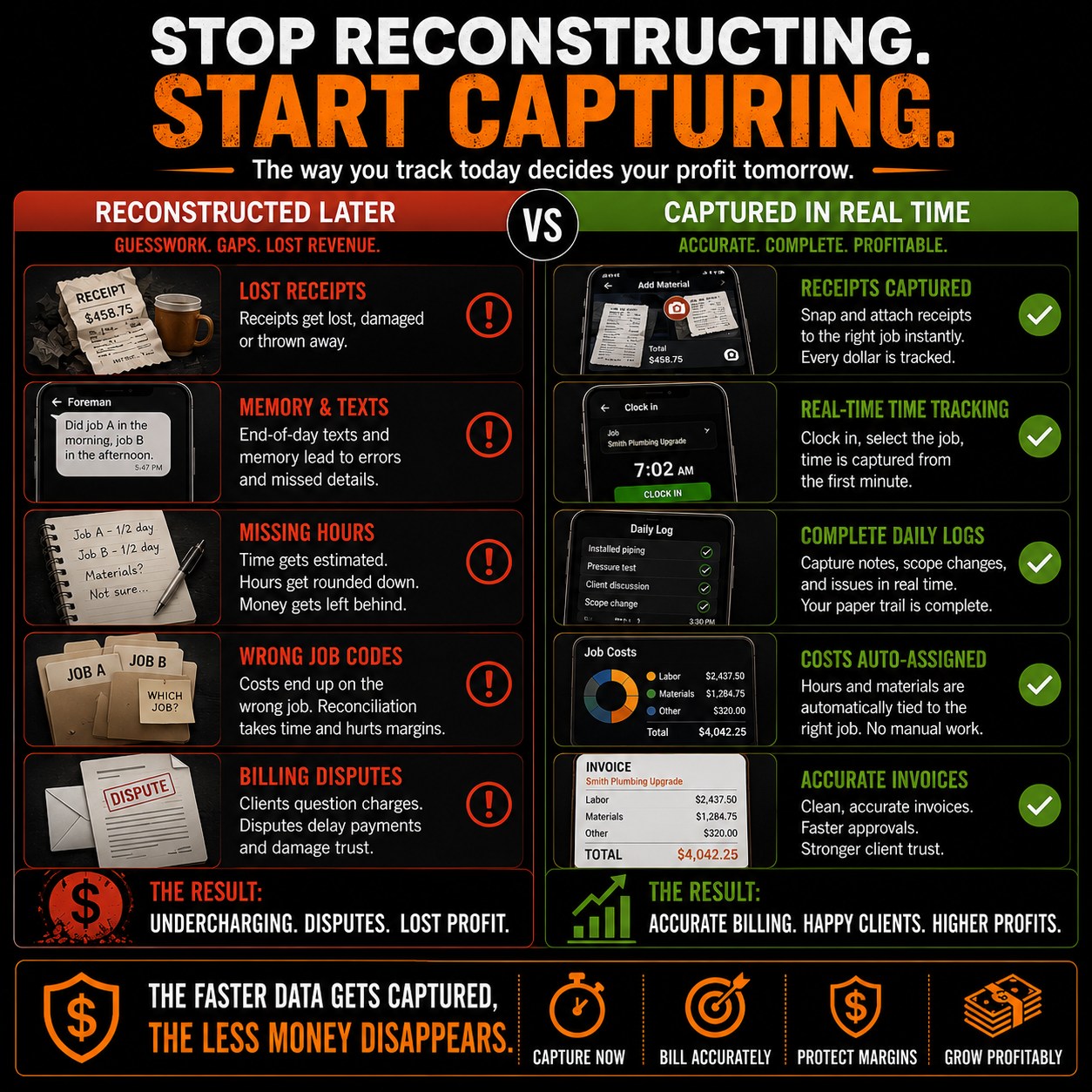
That's the habit. Build the system around it and the data takes care of itself.
Why Standard Time Tracking Tools Fall Short
Most time tracking tools weren't built for T&M work. They handle hours fine. But they don't handle:
• Material cost logging by job code
• Receipt attachment to specific jobs
• Real-time T&M cost vs. budget visibility
• Daily log documentation that serves as a billing paper trail
Here's what that gap looks like in practice.
A service crew spends half a day at one job and half a day at another. They pick up $280 of copper fittings on the way to the second site. Their time tracking app records the hours but has no place for materials and no way to split the day between two job codes. So the foreman texts the office at end of day with his best recollection. The office admin enters what she can interpret. The materials go on whichever job code is easiest to find in the system.
Two weeks later the client on job one gets invoiced for materials that belong to job two. He pushes back. The dispute takes three emails and a phone call to resolve. Nobody is wrong. The system just had no way to capture what actually happened.
For T&M work to be consistently profitable, you need labor, materials, and documentation in one place, all captured in the field, all tied to the right job, all flowing to billing without manual handling.
Generic time tracking gives you half that. You build the rest with spreadsheets. And somewhere in that gap, money disappears.
What It Looks Like When the Gap Is Closed
Pete spent three months building the habit across his 22-person crew. Clock-in with job code. Receipt photo from the truck. Daily log before leaving the site. It took two weeks for it to feel normal and about four weeks for it to feel automatic.
His first fully tracked T&M quarter looked different from every one before it. Not because the crew worked harder or the jobs were more profitable on paper. Because every hour and every material purchase made it to the invoice.
“I knew I was leaving money behind. I just didn’t know how much until I fixed the process and could actually see the difference. The first quarter after we switched, our T&M billing was up 18% on the same volume of work. Same crew. Same jobs. We just stopped losing what we’d already earned.”
Pete S., Owner, Lakeside Plumbing and Mechanical
That's not a software story. That's a habit story. The software just made the habit easy enough to stick.
Ready to Stop Leaving Money on the Table?
TotalTime was built for T&M contractors. Labor and materials tracked to job codes in real time. Daily logs for field documentation. One-click exports to your billing workflow. Nothing gets lost between the job site and the invoice.
• Book a free demo at crm.pathfinderlink.com/get-a-demo, no sales pressure, just real results
• Download the free Payroll Accuracy Guide at crm.pathfinderlink.com/fix-payroll-at-the-source
• Call the TotalTime team directly: 866-360-0449
Built for real job sites. Trusted by teams who don't have time for do-overs.
